
Bad friends
Are you a bad friend?

*PSA: Before I get into this article, I want to say a huge thank you to all the women who got in touch and shared their experiences of friendship with me. I’m incredibly grateful that you trusted me with both the highs and the lows you’ve experienced, and I hope this piece does your stories justice.
While I won’t be able to mention every single person or story, please know that every contribution helped shape this article. Your experiences mattered, and your stories will always stay with me.
I think this will most likely turn into a series because I have so much to say on this subject, but don’t want you to get lost, and I want to include many more of your stories. Think of this as an intro - there will be more to come.*
“Friendship is unique among our close relationships. Marriage and family are institutional, secured by oath and obligation, money and law. Other relationships - for example, between students and teachers , or bosses and employees - have some culturally agreed upon patterns and rules. Friendship is not like that. The obligations are not entirely clear, the responsibilities ill-defined. We cannot always expect our friends to live nearby, or need us in times of crisis, or be there in ours. There is no way to know if the people I call my friends think of me the same way. There is no template for friendship, and how it ought to begin, change or end. Each friendship is so singular, it has to be invented every time.” - Tiffany Watt Smith in her novel Bad Friend.
It was Wednesday last week when a familiar - yet still slightly unfamiliar - feeling of self-doubt crept up on me.
By Friday, something in me had fully awoken. I was full of rage, had zero patience, and found myself pointing fingers.
Fabio (my fiancé) works all hours. He’s a creative working on top-level campaigns with some of the industry’s most talented people. The point I’m trying to make here is that I’m used to his lifestyle. For example, he took a 30-minute work call at our engagement dinner…
Between LA, New York and hearing “one sec, I need to take this,” I eventually hit a wall.
Friday night came, and when the promise to be home by 7pm was - once again -broken, I saw red. Much like Grazia’s cover star this month, I suddenly felt “pigeonholed as someone’s fashionable girlfriend.” Thank you, Sienna.
But the funny part is, it wasn’t really about Fabio. Not even in the slightest.
It was my own shame creeping in - the realisation that maybe I’d been a little bit of an absent friend.
Basically, I missed my friends.
In an attempt at redemption, I immediately reached out to my bestest friend to try and arrange a date. As I scrolled up through our WhatsApp chat, it got me thinking: when did we stop making time for each other - and how do we start again?
It’s something we’ve all said to our girlfriends on the phone: “We must get a date in,” or “I haven’t seen you in months,” or “You need to fill me in on everything that’s happened since last year.”
Case in point: I had a brunch date planned with a friend I haven’t seen since before September 2025.
Never mind - she just texted and her dad is in town.
Sasha ;)
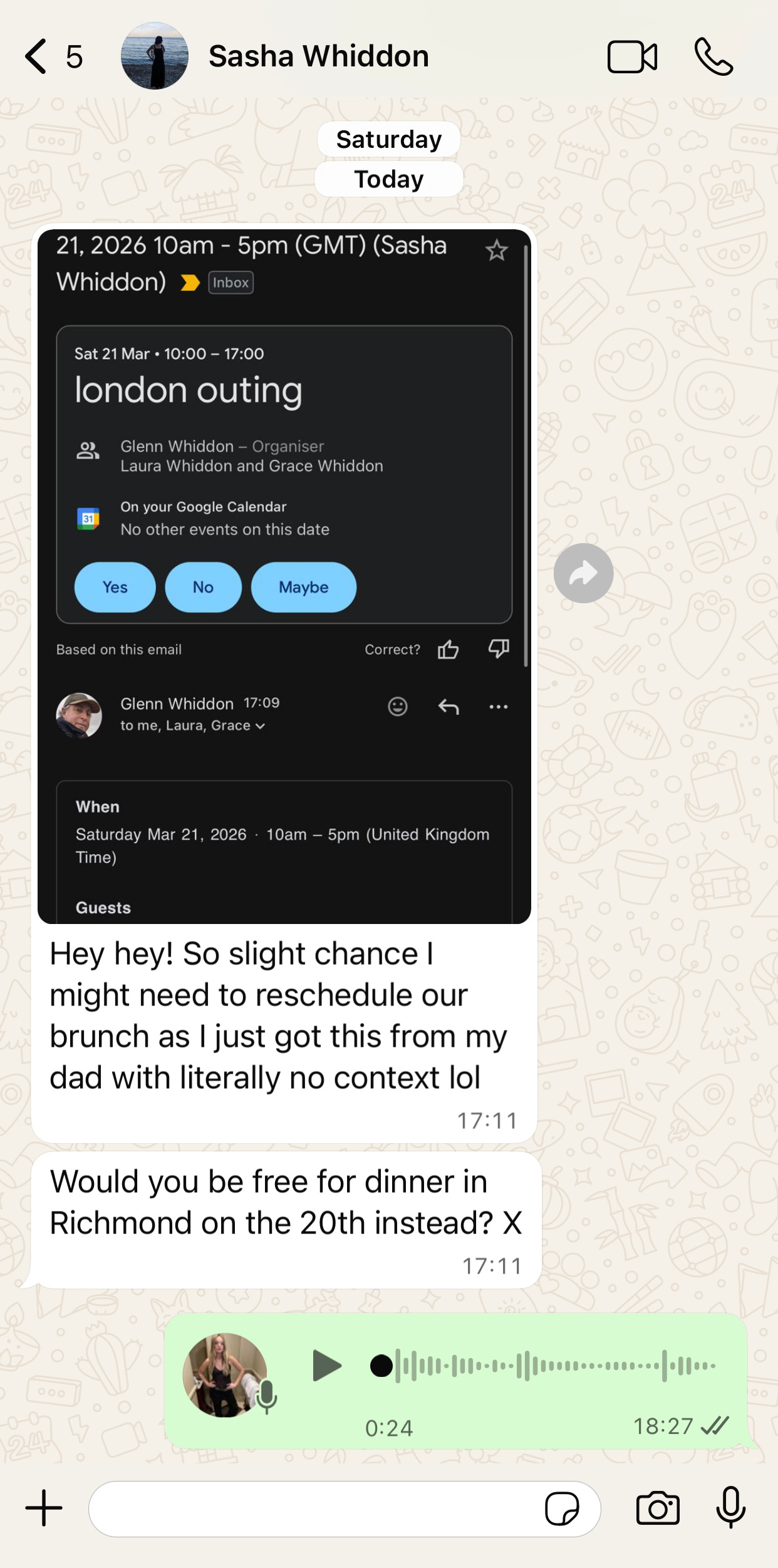
With all this in mind, I pledged to do better - to make the time for my female (and male) friendships, properly.
Saturday morning arrived and I was a little weary-eyed from the two glasses of wine the night before (ever since I hit 25, minimal alcohol equals maximum hangover). Still, I was on a mission.
Luckily for Fabio and me, he was already up and back on set, so he didn’t get the full extent of my still-emotional rage. I had the day to myself.
And that day, thankfully, I had somewhere to be. Remember the artist man (who will remain nameless) who commissioned my first freelance piece? Go read about it here:
Anyway, it was his wife’s (who will also remain nameless) event. She and her business partner run a really cool brand that hosts pop-up events for independent brands - everything from fashion to artisan crafts.
I got ready and, with time to spare, bought myself a coffee and walked to Waterstones on Kensington High Street. Where else would I go to decompress?
Almost immediately after walking in - and after smoking a cigarette outside that had made my anxiety about ten times worse - a pink book caught my eye. It was sitting on one of those little round tables, the ones carefully arranged with signs on top that read “Books of the Month.”
Consciously or not, the title read Bad Friend.
I bought it immediately.
A day later, still carrying a heavy mind, I lay in bed and opened the book. It was everything I needed and more. As I read, I found myself reminiscing about my own friendships and experiences, which, if I’m honest, were a complete shit show throughout my teens, before thankfully settling into something slightly more stable in my twenties.
After shivering at the thought of what my life might have been like had I stayed in my high school friendship group and remained in my hometown, I felt angry, though I wasn’t entirely sure why.
Suddenly, so many unanswered questions flooded my mind. The whole idealisation of women’s friendships felt like an entirely new universe - one I had never properly explored, only followed based on the little I thought I knew.
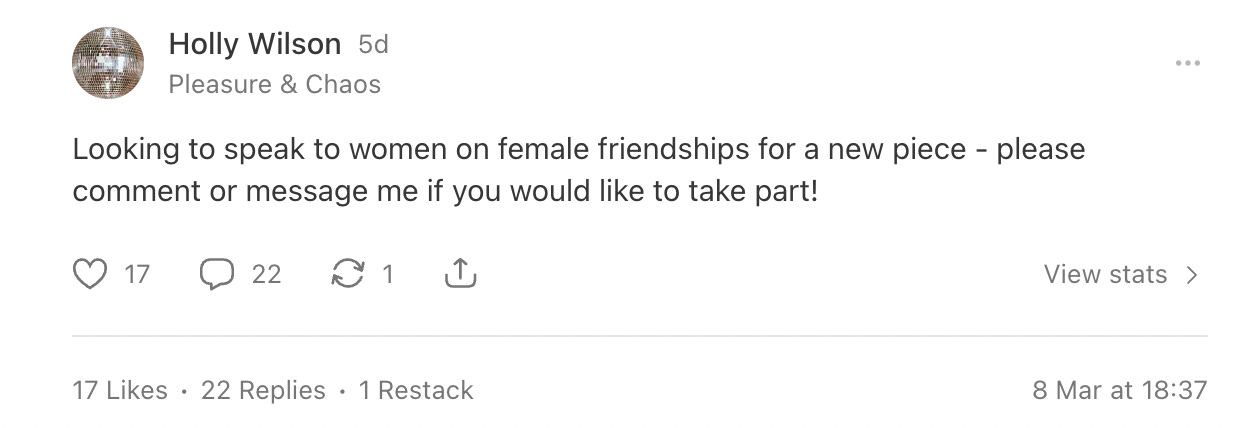
I needed to know more and made a rash decision to put out this note on Substack, which ended up receiving 22 replies:
So here we are.
To those of you I spoke to, you’ll know I rallied a list of questions, sent them over, and then waited.
One of the most common responses I received, among my predominantly female interviewees, was the realisation of how complicated female friendships can be:
“When I was younger, I assumed friendship is simple: you like someone, they like you, and that’s it. But at some point, I started noticing the small shifts - the way people suddenly become colder, the way someone can smile at you and still exclude you later. I realised that friendships between girls can carry a lot of unspoken things: jealousy, comparison, insecurity. None of us are really taught how to deal with those feelings, so they end up showing in quiet ways instead.” vienna
Those words circled in my head for a while: “None of us are really taught how to deal with those feelings, so they end up showing in quiet ways instead.” They took me back to being at school, when each day a different friend would choose not to talk to me. I’d be so upset and couldn’t understand what I had done to warrant being ignored.
Until I got a bit older and stopped giving a fuck, I wouldn’t even ask; I would just do everything in my power to be liked again. Once that was achieved, my subconscious knew I was in power again, and I would then do the same back. How easy it was to reverse my hurt.
The times I’m talking about were probably when I was 12–14. What leads us into these psychological non-verbal power games at such a young age?
Let’s reverse a bit.
My sister and I sitting on my mum’s bed watching her get ready to go out with her friends - we couldn’t have been prouder or more jealous! All we wanted to do was put on some heels and lipstick and go out with our girlfriends. She was the coolest thing in the world: beautiful, strong, independent - the embodiment of everything I saw on TV about what a woman should be.
Sometimes her friends would come round to our house, and Abby and I would sit on the stairs - or, if we were brave enough, with them before bed. It felt like being let into the cool girl group: a bunch of thirty-something women smoking, gossiping, drinking, talking about colleagues or mutual friends. They would pinch our faces and tell my mum how gorgeous we were.
A lot of the time, nice things were said, but of course, they gossiped - who doesn’t with their closest friends? I remember being far too interested in the comments they made about someone they didn’t like. (Before my mum gets cancelled- this was around 2010- times have changed.)
“She’s got a lot bigger recently,” they’d say, and I’d scribble it all into my mental notebook of what it meant to be part of that world.
I fixated on what not to do to be a bad friend, rather than all the things I could do to be a good one. Suddenly, at 13, I had all these rigid ideas of what a friend shouldn’t be. My mum had drilled “girl code” so far into our heads that I couldn’t even fathom that a friend would stab you in the back over a boy. But, of course, that illusion didn’t last long.
I think living with that mindset quickly set the standard for the high expectations I would have of what a woman should be. In the book Bad Friend, which I mentioned at the beginning, Smith writes about younger girls having “crushes” on other girls -usually older than them. Not in a romantic sense, but more like idolising someone famous, seeing them as a figure of admiration and aspiration.
I did this too. Through my teens, I was obsessed with models. A genuine passion for the fashion and music industries was also being born, but oh, how I want to give that girl a hug now. I would replay Victoria’s Secret runways, fashion shows, and scrutinise myself, picking apart every detail that didn’t look like theirs - which, I should add, eventually contributed to a raging eating disorder.
The awful thing was, I wasn’t just scrutinising myself - I was so harsh on other women. I was disgusted by anyone I deemed “lazy” or who didn’t seem to want anything out of life, or fit the kind of mold I saw on TV. I turned my nose up at anyone I thought to be tragic - which, honestly, was basically everyone. All of this was because of what I thought a woman should be, what I expected of my friends, and, of course, the media, TV, and MEN.
Thankfully, I grew up, developed a brain, and quickly realised how narrow-minded, toxic and media trained those thoughts were.
Which got me thinking a lot about the comparison culture among young girls. One of my earliest memories of this was at a friend’s house when we were very young - maybe 10 or 11. Her grandma was there. My friend and I had been playing outside with skipping ropes and ran in for a snack. Her grandma looked at her and said,
“You should try and be a bit prettier and slimmer, like your friend.”
Even at that young age, I was so confused - I couldn’t wrap my head around why an older woman would care about the minor weight differences of 10- and 11-year-olds.
I took this question to you all:
“Growing up, were you ever compared to other girls - whether in appearance, grades, or behaviour? How did that shape the way you saw your friendships?”
I got some very interesting answers. One reader wrote:
“Unfortunately yes. My mom was competitive herself and many of her comments or opinions revolved around comparison or the idea of wanting to be better than. She wasn’t necessarily comparing me to anyone in particular, but just the idea of ‘I don’t think girls wearing this look good’ or ‘girls should act like this’ and ‘you don’t want to be looped in with other girls’ who weren’t up to her standards. Obviously, as I got older, I formed my own opinions, but it was a conscious effort to break out of that thought pattern engraved into my mind as a young girl.” Nicole Halverson
In some ways, this reinforces the same ideals I had about how a woman should behave, look, and act - and the pressure that comes with trying to measure up.
The group of women you surround yourself with in your early twenties matters more than you realize. For so many reasons:
You’re all navigating how messy and unforgiving life can be.
They can be your safety net - or your biggest enemy.
You will never laugh as much as you do with a group of girlfriends in your early twenties.
They can shape your path as you grow - sometimes in ways you don’t even notice until years later.
The friendships we form at that age are formative. They test us, support us, and show us both the best and the worst of who we are. Choosing who you let close enough to influence your life becomes an act of self-preservation as much as it is about connection.
I’ve been lucky enough to have a solid friendship group through my sister - her friends, which of course are now mine. I must also note that my sister isn’t just family -she is, without a doubt, my bestest friend in the whole world.
These women have been a constant presence in my life. They’ve celebrated the highs, steadied me through the lows, and reminded me what real friendship feels like: loyal, playful, and uncomplicated.
And of course, I’ve made my own special bonds too -through uni, work, and other chapters of life - some fleeting, some six years strong.
The point I’m trying to make-though we all know it, and somehow still forget-is this: do not neglect your friendships. Not for a man, not for a job, not for anything.
I think this will most likely turn into a series because I have so much to say on this subject, but don’t want you to get lost, and I want to include many more of your stories. Think of this as an intro-there will be more to come.
Please feel free to message me on any subjects or if you would like to have your say in the next piece and again thank you to those who have shared your stories with me.
Holly xx
“Choosing who you let close enough to influence your life becomes an act of self-preservation as much as it is about connection” so true! Really enjoyed reading this
I was waiting for this piece since I saw your note! So important how you mention observing your mum with her friends - I agree it’s so formative. I’ll look out for the next one, I’d love to join in x